
PTSD After Miscarriage and What No One Told You
PTSD after miscarriage and what no one told you would hurt. I mean, obviously. I knew there would be grief and crying and that weird moment when someone asks how you are doing and you have to decide whether they want the actual answer or the grocery store answer.
What I did not understand was why my body kept acting like it was still happening.
Why I could be standing in a completely normal room and suddenly feel sick. Why certain places made my chest tighten before I had even figured out what I was remembering. Why I could get through work and answer messages and appear pretty functional, actually, and then completely fall apart because I saw the same kind of soap dispenser that had been in the clinic bathroom.
That sounds absurd when I type it. It was a soap dispenser. But trauma does not care whether a reminder seems logical.
And so when people talk about PTSD after miscarriage, this is what they mean. The miscarriage ended, but part of your mind and body may still be reacting like the danger is happening now.
That does not mean every person who miscarries develops PTSD. It does not mean intense grief is automatically a mental health diagnosis either. It means miscarriage can be both a loss and a frightening event, and sometimes those two things get tangled together in ways nobody warned you about.
Can You Have PTSD After a Miscarriage
Yes, some people develop post traumatic stress symptoms after a miscarriage, and some meet the full requirements for PTSD.
One of the largest studies following women and their partners after early pregnancy loss found that 34 percent of the women met a screening threshold for post traumatic stress symptoms one month after the loss. That number was 26 percent after three months and 21 percent after nine months. These were screening results, not confirmed diagnoses from individual evaluations, and that difference matters because a questionnaire cannot diagnose you. Still, the findings tell us that lasting trauma symptoms after miscarriage are not rare or imaginary. (Ultrasound in Obstetrics and Gynecology) I think this is where people get confused because miscarriage is often discussed only as grief.
You lost a pregnancy, so of course you are grieving.
But maybe you also experienced heavy bleeding in a bathroom while trying to figure out whether you needed help. Maybe someone told you there was no heartbeat and then immediately started talking about scheduling. Maybe you waited in a room surrounded by pregnant people while knowing your pregnancy had ended. Maybe you felt trapped in your own body and completely unable to stop what was happening.
You can grieve the baby and feel traumatized by what happened. Both can be true at the same time.
Post Traumatic Stress Symptoms Are Not Always PTSD
Having nightmares, panic, unwanted memories, or a strong reaction to reminders does not automatically mean you have PTSD.
According to the National Institute of Mental Health, PTSD symptoms must last longer than one month, include several types of trauma reactions, and interfere with daily life. A trained mental health professional is the person who can determine whether your symptoms fit that diagnosis. I am not going to give you a quiz where you count six boxes and suddenly decide your brain is broken.
That is not helpful.
What may be helpful is noticing what has changed since the miscarriage and how much those changes are controlling your life.
Are you avoiding appointments you need because walking into the building feels impossible?
Are you waking up from the same nightmare several nights a week?
Are you checking for blood every time you use the bathroom, even months later?
Are you snapping at your partner because your whole body feels on guard all day?
Are you unable to talk about what happened because the second you try, it feels like you are back there?
Those reactions deserve attention whether or not they eventually receive a specific name.
Grief, Acute Stress, and PTSD Can Look Similar
This part can get confusing because grief and trauma share some of the same feelings. Both can bring sadness, anger, guilt, sleep problems, and difficulty concentrating.
So, OK, this is not a perfect little chart because human beings are not perfect little charts, but it gives you somewhere to start.
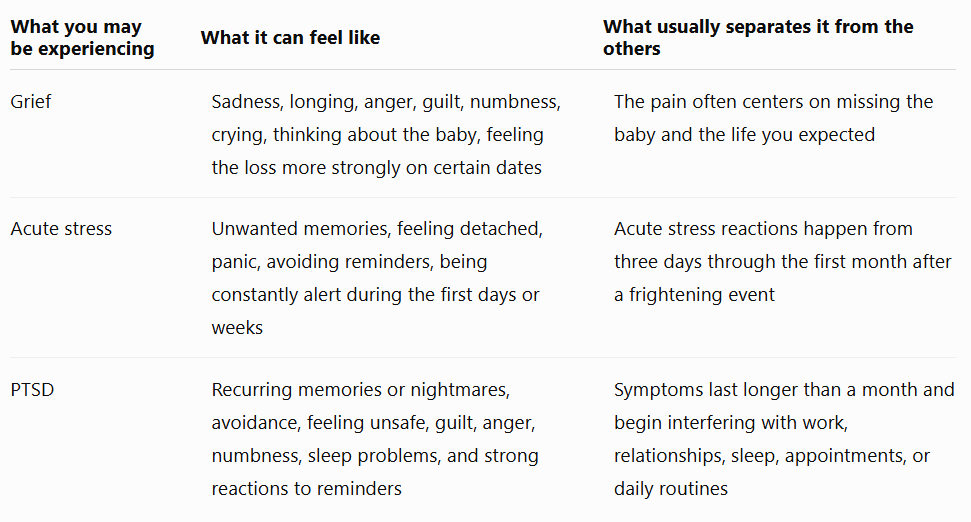
The National Center for PTSD explains that acute stress symptoms occur during the first month after trauma, while PTSD is considered when symptoms continue beyond that first month. ef does not follow a schedule though. You can feel mostly steady for a while and then get knocked flat by your due date, a pregnancy announcement, a smell, a song, or the aisle in Target that you did not realize you had been avoiding.
That is grief being grief.
The part I pay attention to is whether your mind and body keep responding as though you are still in danger.
What PTSD After Miscarriage Actually Looks Like
PTSD after miscarriage does not always look dramatic from the outside.
Sometimes it looks like someone who goes back to work on Monday.
Sometimes it looks like someone who keeps making dinner, keeps getting the other kids ready for school, keeps answering emails, and then sits in the car because going inside the doctor’s office feels impossible.
Sometimes it looks like laughing at a joke and then feeling guilty because how could you laugh when your baby died.
Sometimes it looks like nothing, which is part of why nobody notices.
The Memory Keeps Barging In
You may replay the moment you learned the pregnancy had ended.
You may remember the exact expression on someone’s face, the lighting in the room, the paper beneath your legs, the sound of a machine, or the sentence that changed everything.
These memories may appear when you are trying to sleep or driving or showering or doing something wildly unrelated, like loading the dishwasher. The National Institute of Mental Health lists recurring memories, dreams, distressing thoughts, flashbacks, and physical stress reactions among the main ways traumatic events can return. may feel like a memory.
Or it may feel like you are back there.
That difference is hard to describe until it happens.
Your Body Reacts Before You Can Think
Maybe your heart starts racing when you walk into a clinic.
Maybe you see blood and suddenly feel shaky, dizzy, nauseated, or unable to breathe normally.
Maybe you hear someone describe their first ultrasound and your shoulders move toward your ears and stay there for the rest of the conversation.
PTSD can include feeling tense, easily startled, constantly alert, irritable, unable to concentrate, or unable to sleep, according to the National Institute of Mental Health. hard part is that your thinking brain may understand that you are safe while the rest of you is yelling absolutely not.
And then people tell you to relax, which is obviously incredibly useful. Like wow, thank you, I had not considered relaxing.
You Start Avoiding Anything That Brings It Back
Avoidance can be obvious.
You stop driving past the hospital. You cancel an appointment. You mute every pregnant person online. You put the ultrasound photos in a drawer and cannot open it.
It can also be quieter.
You change the subject when someone mentions the miscarriage. You never wear the clothes you had on that day. You stop going to the restaurant where you were sitting when the cramping started. You avoid trying to become pregnant again even though part of you still wants to, because wanting another baby now feels connected to terror.
Avoiding thoughts, feelings, places, objects, and situations connected to an event is one of the core PTSD symptom groups described by the National Institute of Mental Health. idance makes sense in the moment because it gives you relief.
But your world can start getting smaller without you noticing.
You Feel Numb, Angry, Guilty, or Far Away
Some people cry constantly after a miscarriage.
Some cannot cry at all.
Some feel furious. Some feel detached from their partner. Some cannot tolerate anyone touching them. Some feel like they are watching their own life through glass.
You might blame yourself even when you have been told the miscarriage was not your fault.
Maybe you keep going back over everything you ate, lifted, thought, forgot, or did not do. Maybe you search for a moment where you could have changed the ending because accepting that you could not control it feels worse.
PTSD can include ongoing fear, anger, guilt, shame, self blame, isolation, loss of interest, and difficulty feeling happiness, according to the National Institute of Mental Health. yes, grief can include those feelings too.
The question is not whether you are grieving correctly. There is no correct version.
The question is whether these reactions feel stuck and whether they are keeping you from living the parts of your life that still exist.
You Look Fine and Are Absolutely Not Fine
This is the one I wish more people understood.
Being able to function does not tell us how much pain someone is carrying.
You can shower, work, smile, care for children, go to dinner, and answer every text while also sleeping three hours a night and checking the toilet paper every time you use the bathroom.
You can be funny while you are falling apart. Some of us get funnier, actually. It is not funny but it is kind of funny because apparently the brain will do anything for five seconds of oxygen.
Other people may think you are doing better because you stopped mentioning the miscarriage.
Maybe you stopped mentioning it because every response made you feel worse.
“At least you know you can get pregnant.”
“You can try again.”
“Everything happens for a reason.”
No. Sometimes something awful happened and you are trying to figure out how to buy groceries afterward.
Why Symptoms Can Appear Weeks or Months Later
PTSD symptoms often begin within three months of a traumatic event, but the National Institute of Mental Health says they can also emerge later. t delayed reaction can scare people because they think they were doing fine.
Maybe you were not doing fine. Maybe you were busy surviving.
During the first few weeks, you may be dealing with appointments, physical pain, bleeding, work, childcare, relatives, bills, paperwork, and people asking questions you do not know how to answer.
There may not be room to understand what happened because you are still handling what happened.
Then things quiet down and your mind goes, OK so now we are apparently going to replay this at 2:17 every morning.
Reminders Can Bring Everything Back
The expected due date can do it.
Another pregnancy can do it.
A routine appointment can do it.
A friend’s announcement can do it, even when you love that friend and are genuinely happy for them, which is a very confusing emotional sandwich nobody asked for.
A smell, a bathroom, an exam room, a certain month, a pair of underwear, or a meal you could not eat afterward can do it.
Trauma reminders do not have to make sense to anyone else.
Your body remembers the connection even when you would very much prefer it did not.
Pregnancy After Loss Can Wake Up Old Fear
A new pregnancy does not erase what happened before.
You may want the pregnancy desperately and still feel unable to trust it. You may check symptoms all day. You may feel terrified before scans. You may avoid buying anything for the baby because planning feels dangerous now.
Recent research on pregnancy after miscarriage has found that earlier pregnancy loss can affect emotional attachment and feelings during a later pregnancy, and research has also linked pregnancy loss related trauma symptoms with higher anxiety and depression during a later pregnancy. (Midwifery, Journal of Advanced Nursing) s does not mean you will never feel connected to another pregnancy.
It means another pregnancy may bring hope and fear into the room at the same time, and wow, they are loud roommates.
When the Care Itself Becomes Part of What Hurt
Sometimes the miscarriage is not the only part your mind keeps replaying.
Maybe someone gave you devastating news while staring at a screen.
Maybe nobody explained what would happen next.
Maybe you were left waiting in pain.
Maybe you were spoken to like this was a routine inconvenience because it was routine for them.
Maybe you were sent home with instructions and no idea what you were about to experience.
Maybe the person caring for you was kind, but the room, the waiting, the pain, and the lack of control were still frightening.
The World Health Organization states that people experiencing pregnancy loss deserve respectful care that recognizes the loss and offers emotional support. s is not about saying every difficult medical experience is someone’s fault.
It is about recognizing that feeling dismissed, confused, exposed, unheard, or trapped can become part of what hurt.
And sometimes the sentence that stays with you is not even the diagnosis. It is what somebody said afterward.
“You were only eight weeks.”
Only.
As if you had only rearranged your entire future a little bit.
Partners Can Struggle Too and Almost Nobody Asks
Partners can develop trauma symptoms after miscarriage too.
In the same multicenter study, 7 percent of partners met the screening threshold for post traumatic stress symptoms after one month, 8 percent after three months, and 4 percent after nine months. These rates were lower than the rates among the women who physically experienced the loss, but the symptoms were still real. (Ultrasound in Obstetrics and Gynecology) tners may have watched someone they love bleed, collapse, cry, or go through a procedure they could not stop.
They may have felt responsible for staying calm.
They may have handled phone calls, food, children, appointments, or family updates and then realized nobody had asked them what they saw or how scared they were.
Partners may also grieve differently.
One person may need to talk. The other may go quiet.
One may want to try for another pregnancy soon. The other may feel terrified.
One may appear to return to normal faster, which can feel like abandonment even when they are hurting privately.
Different reactions do not always mean one person cared more.
But silence can turn different reactions into distance, and that distance can become another painful thing sitting in the house with you.
When It May Be Time to Talk to Someone
You do not have to wait until you are completely falling apart.
You also do not need therapy just because someone else thinks grief should have expired by now.
It may be time to talk with a trained professional when the reactions continue for more than a month, grow stronger, or start interfering with sleep, work, parenting, relationships, medical care, or daily routines. Those are also parts of how professionals assess PTSD, according to the National Institute of Mental Health. attention when you notice things like
Recurring nightmares or memories you cannot control
Panic or strong physical reactions to reminders
Avoiding needed appointments
Feeling constantly alert or unable to rest
Anger that feels difficult to control
Feeling detached from your partner, children, friends, or yourself
Being unable to talk or think about the miscarriage without feeling like it is happening again
Fear that takes over another pregnancy
Using alcohol or other substances to shut the feelings down
Thoughts of hurting yourself or not wanting to be alive
If you may harm yourself or cannot stay safe, contact your local emergency service now. You can also use Find a Helpline to locate a verified crisis service in your country. The directory works with helpline organizations across more than 175 countries. What Support Can Actually Look Like
Support after miscarriage should not force you into a neat story about becoming stronger.
Maybe you do become stronger in some ways. I do not know. Maybe you also become someone who cannot walk into a certain restaurant anymore because your body remembers what your mind is trying not to.
Both can exist.
Trauma Therapy
Trauma therapy can help you understand why certain reminders create such a strong reaction and why your body behaves as though the event is still happening.
It may involve learning how to notice when you are being pulled back into the memory, finding ways to return to the present, talking about the parts that still feel unfinished, and slowly reducing avoidance.
The goal is not to convince you that the miscarriage did not matter.
The goal is not to make you forget your baby.
The goal is to help the memory become a memory instead of something your body keeps reliving.
EMDR
EMDR stands for Eye Movement Desensitization and Reprocessing.
Yes, it is a terrible name. It sounds like something involving a printer.
During EMDR, you focus on parts of a painful memory while a therapist guides alternating movements, sounds, or taps. You remain awake and aware, and you do not have to describe every detail aloud.
The National Center for PTSD describes EMDR as one of the most studied therapies for PTSD, and several major treatment guidelines give it their strongest recommendation. The research is for PTSD from many kinds of trauma, not miscarriage alone, so no ethical therapist should promise that it will work the same way for every loss. some people after miscarriage, EMDR may focus on the moment they learned there was no heartbeat, a frightening experience at home, a procedure, a hospital room, or the belief that their body failed them.
You and the therapist decide what to work on and when.
You are not dropped into the worst memory on the first day because apparently we are trying to help, not ruin your Tuesday.
Grief Counseling
Grief counseling may be a good fit when the deepest pain centers on missing the baby, losing the future you imagined, feeling disconnected from other people, or trying to live with questions that do not have satisfying answers.
You may need room to talk about the baby as a baby.
You may need to say the name you chose.
You may need to talk about how other people moved on because they did not understand that your whole life had split into before and after.
Grief and PTSD can exist together, so support does not always fall into one tidy category.
Support Groups
A pregnancy loss support group can help you speak with people who understand why a miscarriage from years ago can still matter.
The American College of Obstetricians and Gynecologists includes counseling and support groups among the options people may consider after pregnancy loss. ups are not for everyone.
Some people feel comforted by shared stories. Some feel flooded by them. Some like listening without speaking for a while.
You are allowed to notice what helps and what leaves you feeling worse.
What I Wish Someone Had Told Me
I wish someone had told me that I could be grieving and traumatized.
I wish someone had explained that being able to work did not mean I was fine.
I wish I had known that a body can react to a memory before the mind catches up, and that this can make you feel like you are losing it when actually your alarm system got stuck on.
I wish people understood that another pregnancy does not replace the one that ended.
And I really wish someone had told me that I did not have to keep explaining why it mattered.
If you are dealing with nightmares, panic, avoidance, anger, guilt, numbness, or fear after miscarriage, you do not have to decide by yourself whether it is grief or trauma or both. You can talk with someone who understands pregnancy loss and will not rush you into making the story easier for other people to hear.
Whole Mother offers support for mothers and families living with pregnancy loss, grief, and trauma.
Maybe you are ready to talk about it.
Maybe you are still trying to figure out what the hell happened.
Anyway, you can start there.
Frequently Asked Questions
Can a Miscarriage Really Cause PTSD
Yes. Research has found that some people experience lasting post traumatic stress symptoms after miscarriage, and some may meet the full requirements for PTSD. A multicenter study found that 34 percent of women met a screening threshold one month after an early pregnancy loss, though screening results are not the same as a confirmed diagnosis. (Ultrasound in Obstetrics and Gynecology) How Soon Can PTSD Symptoms Begin After a Miscarriage
Trauma reactions can begin immediately, but PTSD is considered only when the symptoms last longer than one month and interfere with daily life. The National Center for PTSD uses the term acute stress for similar symptoms occurring during the first month. How Can I Tell the Difference Between Grief and PTSD
Grief often centers on sadness, longing, anger, and missing the baby or the future you expected. PTSD is more likely to include repeated reliving, strong physical reactions, avoidance, feeling constantly unsafe, and changes that disrupt work, sleep, relationships, or daily routines. A mental health professional can help sort out whether you are experiencing grief, trauma symptoms, or both. (National Institute of Mental Health) Can a Partner Develop PTSD After a Miscarriage
Yes. Partners can experience helplessness, unwanted memories, avoidance, fear, depression, and post traumatic stress symptoms after pregnancy loss. One study found that 7 percent of partners met a trauma symptom screening threshold after one month, 8 percent after three months, and 4 percent after nine months. (Ultrasound in Obstetrics and Gynecology) Can EMDR Help With PTSD After Miscarriage
EMDR is a well studied therapy for PTSD and may help reduce distress connected to traumatic memories. Research has examined EMDR across many trauma types rather than miscarriage alone, so results vary and treatment should be shaped around your symptoms, history, and comfort level. (National Center for PTSD)
The draft is ready for publication review. The strongest next edit would be adding one or two verified details from Jennie’s own miscarriage story, because invented personal scenes would weaken trust rather than strengthen her voice.